Stairs, Ice, and Mobility: Fall Prevention for Colorado Homes in Loveland
For families caring for an older parent, a fall can change the way everyone thinks about home. A staircase that once seemed completely ordinary may suddenly feel intimidating. A patch of winter ice outside the front door can become a serious concern. Even everyday walking around the house may require more attention when balance or mobility changes.
These concerns can be especially important in Loveland, where Colorado weather can bring snow and ice to sidewalks, driveways, steps, and entryways. At the same time, many older adults want to remain in the homes and communities they know.
Fall prevention does not mean making a parent feel restricted or afraid to move. It means looking thoughtfully at the home, identifying hazards, supporting safe mobility, and providing help when an older adult needs it. This guide explains practical fall-prevention considerations for Loveland families and how non-medical home care can support safer everyday routines.
Why Fall Prevention Matters for Older Adults
Falls can happen during ordinary activities.
A person may lose balance while getting out of a chair, walking to the bathroom, stepping onto a porch, or using the stairs. A slippery floor, poor lighting, clutter, or an unstable walking surface can add to the risk.
The Touching Hearts caregiver handbook identifies falls as a leading cause of unintentional home injuries and emphasizes the importance of identifying fall risks and taking steps to reduce them.
That makes prevention an everyday responsibility rather than something families should think about only after an accident.
The goal is to notice potential problems before they become emergencies.
For an older adult in Loveland, that can mean paying attention to both indoor and outdoor areas of the home, particularly when winter weather changes the conditions around the property.
Start With the Walkways
One of the simplest fall-prevention steps is keeping walking paths clear.
During each visit, Touching Hearts caregivers are instructed to inspect walkways and keep these areas clear. The handbook specifically identifies oxygen tubing as an additional trip hazard and recommends using night lights in hallways and bathrooms where lighting is poor.
Families can apply the same principle throughout the home.
Look at the paths your parent uses most often:
- Bedroom to bathroom
- Bedroom to kitchen
- Living room to kitchen
- Entryway to living areas
- Stairways
- Routes to frequently used chairs or tables
Ask yourself whether anything is in the way.
Loose objects, cords, small rugs, piles of clothing, shoes, boxes, or other household items can make a familiar route more difficult to navigate.
Keeping these areas organized does not have to mean changing the entire home. Often, a few simple adjustments can make everyday movement easier.
Pay Special Attention to Stairs
Stairs deserve particular attention because they combine changes in elevation with balance, foot placement, and movement.
The Touching Hearts handbook identifies stairways as a high-risk area when appropriate safety precautions are not used. It recommends good lighting at the top and bottom of stairs and checking for worn or loose carpeting, carpet tracks, temporary storage, and decorative items.
Take a close look at the staircase in your parent’s home.
Keep Stairways Well Lit
A person needs to see where each step begins and ends.
Make sure lighting is available at both the top and bottom of the staircase. Nighttime trips can be particularly challenging when a person is tired or the surrounding area is dark.
Night lights may also help along routes that your parent regularly uses after bedtime. Touching Hearts specifically recommends night lights in poorly lit hallways and bathrooms.
Keep Steps Free of Items
Do not use stairs as temporary storage.
Shoes, packages, clothing, baskets, decorations, and other objects can create obstacles.
A clear staircase provides a more predictable walking path.
Check Carpeting and Rugs
The Touching Hearts handbook recommends inspecting stairs for worn or loose carpeting and checking rugs at the top or bottom of stairways to ensure they have skid-resistant backing or carpet tape.
If something on or around the stairs moves when stepped on, it deserves attention.
Use the Handrail
Touching Hearts guidance recommends that clients utilize stair railings when using stairs and, whenever possible, approach the handrail horizontally and grip it with both hands.
For a parent whose balance has become unreliable, families should not assume that simply having a railing makes the stairs safe enough.
The person’s ability to support their own weight and navigate the stairs also matters.
Mobility Support Should Encourage the Senior to Participate
When an older adult needs assistance walking, the purpose of support is not to physically move them through the house.
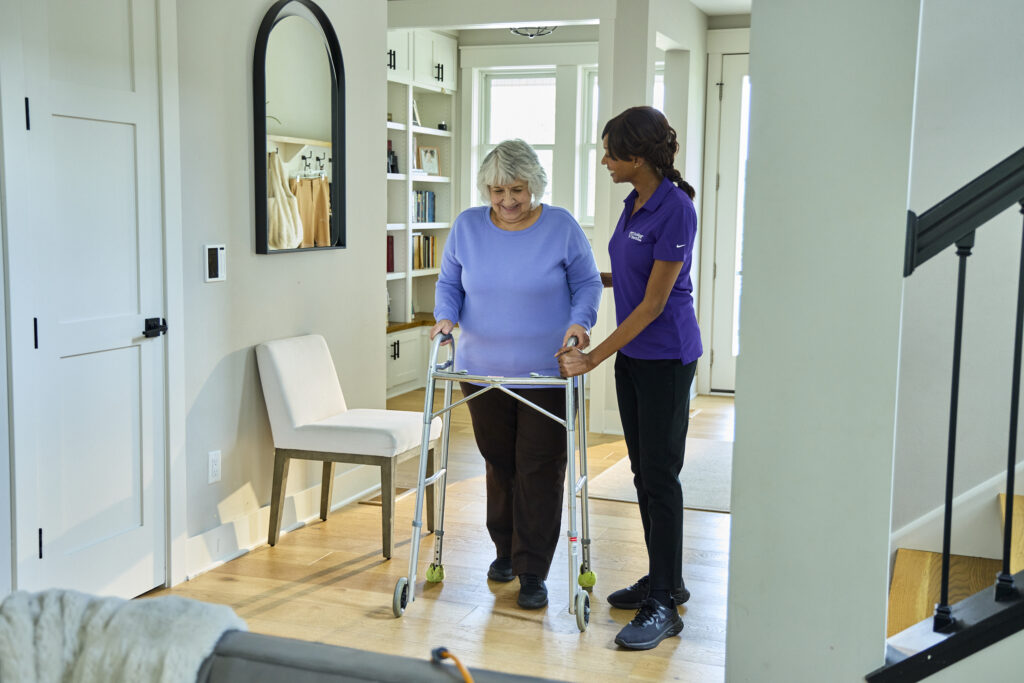
The Touching Hearts handbook explains that the client should be able to do most of the work while the caregiver provides stability and confidence. Caregivers are instructed to understand their limitations and contact the office if a client asks for more physical assistance than the caregiver can safely provide.
This is an important principle for families.
A parent may need a steadying hand without needing someone to carry or lift them.
Encouraging appropriate participation can help preserve dignity while keeping assistance focused on safety.
Allow Time to Get Balanced
Moving too quickly can make an unstable situation worse.
The handbook’s mobility guidance emphasizes allowing a client time to become balanced and steady before moving away from them.
That can be especially relevant when someone is getting up from a bed or chair.
A few extra moments can make the transition less rushed.
Walking Support Requires Attention to the Individual
A person’s balance and strength can vary.
Touching Hearts’ walking guidance recommends that caregivers position themselves on the client’s weaker side and slightly behind while walking with an unstable or elderly person. When appropriate, a transfer belt may be used, and caregivers should move in step with the client.
The guidance also provides specific positioning for assisting with stairs.
When helping a client walk upstairs, the caregiver stays a step or two below the client. When helping a client walk downstairs, the caregiver walks behind them.
However, the handbook makes an important limitation clear: caregivers should not walk on stairs with an unreliable, unsteady client who cannot totally support their own weight.
Families should take that limitation seriously.
If your parent needs more physical assistance than the caregiver or care plan safely allows, the appropriate step is to contact the office and discuss the change rather than attempting an unsafe transfer.
Colorado Ice and Snow Create Seasonal Challenges
Loveland families have to think beyond the inside of the home.
Colorado winter weather can change outdoor walking conditions quickly. Snow and ice may collect on sidewalks, driveways, steps, and pathways leading to the front or side entrance.
Touching Hearts’ fall-prevention guidance specifically recommends checking outdoor walkways and stairs leading to an entryway and keeping paths clear of debris, obstructions, ice, and snow. It also emphasizes appropriate lighting and clean walking surfaces.
This is especially important for an older adult who normally walks independently.
A route that was safe yesterday may not be safe after an overnight freeze.
Check Before Your Parent Goes Outside
Before a senior walks from the home to a vehicle, mailbox, driveway, or sidewalk, take a moment to look at the path.
Ask:
- Is there ice?
- Is snow covering uneven areas?
- Is the walkway adequately lit?
- Are there objects blocking the path?
- Are stairs clear?
- Is the walking surface wet or slippery?
- Does your parent have appropriate footwear?
The handbook recommends appropriate footwear as part of fall prevention.
A few minutes of preparation can help avoid a rushed or unstable walk.
Bathrooms Need Special Attention
Bathrooms are another area where falls can occur because water and smooth surfaces can create slippery conditions.
Touching Hearts’ mobility guidance recommends using grab bars when available around the bathtub, shower, and toilet. It also recommends non-slip strips in the tub or shower and a bathmat with a non-skid bottom next to the tub or shower.
A senior should not use a towel bar as a substitute for a safety support.
When assisting someone out of a tub or shower, the handbook recommends allowing the client to dry their upper body and put on a robe before getting out when appropriate.
The caregiver should also avoid rushing the client during bathroom routines.
A calm, deliberate pace can be important when balance is a concern.
Lighting Can Make Everyday Movement Easier
Poor lighting can make obstacles harder to see.
This is especially relevant at night when a parent gets out of bed to use the bathroom or walk into another room.
Touching Hearts’ fall-prevention guidance recommends night lights in hallways and bathrooms in poorly lit areas and for nighttime assistance.
Families can look at the home from their parent’s perspective.
Are stair edges easy to see?
Can the path to the bathroom be clearly identified?
Is the entryway well lit?
Are there dark corners or areas where objects blend into the surroundings?
Good lighting does not eliminate every fall risk, but it can make the environment easier to navigate.
Decluttering Can Reduce Trip Hazards
A tidy home is not just about appearance.
Clutter can interfere with safe movement.
Touching Hearts’ housekeeping guidance recommends beginning by decluttering the home, including picking up items left on floors and stairs, clearing tables, washing dishes, emptying waste baskets, and taking out garbage and recycling.
Caregivers are also instructed to clean only what is within reach and never climb onto a ladder or stool over two feet tall.
That limitation is important because fall prevention applies to caregivers, too.
No one should create a new safety risk while trying to clean or organize the home.
Footwear Matters
Shoes can influence how securely a person moves around the home.
Touching Hearts’ fall-prevention guidance encourages clients to wear appropriate footwear.
Families may want to pay attention to what their parent wears when moving around the house.
If your parent frequently walks in loose footwear or socks on potentially slippery surfaces, discuss safer options with their care team and healthcare professionals as appropriate.
The important point is consistency.
A safe walking surface works best when the person also has appropriate support from their footwear and mobility abilities.
What to Do If a Parent Falls
Even with careful prevention, falls can still happen.
Knowing what to do afterward matters.
Touching Hearts’ handbook instructs caregivers not to attempt to move an injured client. If a client appears injured, emergency procedures should be followed, and appropriate help should be summoned.
If the client is alert, uninjured, and able to follow directions, the handbook provides a specific procedure for helping them rise from the floor without pulling or lifting them.
Families should not assume they can safely lift a parent from the floor themselves.
A fall can involve an injury that is not immediately obvious.
Touching Hearts also requires all falls to be reported to the office, regardless of injury or outcome.
If your parent has experienced a fall and you are concerned about injury or medical attention is needed, follow appropriate emergency procedures.
Watch for Changes in Mobility
Sometimes a fall is not the first sign that something has changed.
You may notice that your parent:
- Takes longer to stand up
- Holds onto furniture while walking
- Avoids the stairs
- Moves more cautiously
- Has trouble getting into or out of a chair
- Needs more help in the bathroom
- Seems less steady than before
- Has become reluctant to leave the house
These observations are worth discussing with the appropriate healthcare professional and care team.
A change in mobility may mean that the existing support plan needs to be reviewed.
Touching Hearts’ mobility guidance emphasizes that the caregiver should assist the client rather than physically move them and should contact the office when the client requires more assistance than the caregiver can safely provide.
The goal is to respond to changes rather than simply hoping they resolve on their own.
How Home Care Can Support Fall Prevention
Non-medical home care can provide another set of eyes in the home.
A caregiver may help maintain clear walking areas, assist with appropriate mobility according to the care plan, provide companionship, support personal-care routines, and report hazards or changes that could affect safety.
Touching Hearts emphasizes that caregivers should think about home safety every day and contact the office with safety questions or concerns.
That ongoing awareness can be valuable for families.
An adult child may only visit a few times each week. A caregiver may have more opportunities to notice that a rug has shifted, a walkway has become cluttered, or a parent is moving differently than before.
Caregivers do not diagnose the reason for a change in mobility. Instead, they observe, document, and communicate according to the appropriate care procedures.
Creating a Safer Winter Routine in Loveland
For Loveland families, fall prevention can be especially useful when winter weather arrives.
Consider creating a simple routine around outdoor mobility.
Before your parent leaves the house, check the walkway.
After a snowstorm or freeze, inspect the stairs and entry area again.
Keep necessary paths clear.
Make sure lighting is available.
Encourage appropriate footwear.
If your parent has difficulty navigating outdoor conditions, consider whether they need assistance rather than expecting them to manage a hazardous surface alone.
Touching Hearts’ guidance specifically recognizes ice and snow as outdoor fall hazards and recommends keeping walkways and paths free of these obstructions.
Colorado weather can change quickly, so a safety routine that becomes habitual may be easier to maintain than making decisions only after conditions become difficult.
Helping an Older Adult Feel Safe Without Feeling Restricted
Fall prevention should not make your parent feel as though they are being watched every moment.
Older adults deserve dignity and the opportunity to remain involved in their own daily routines.
The Touching Hearts mobility guidance emphasizes allowing the client to do most of the work while the caregiver provides stability and confidence.
That philosophy can apply beyond walking.
Ask your parent what feels difficult.
Listen to which activities they want to continue doing.
Find out which areas of the home make them uncomfortable.
Then look for ways to provide appropriate support.
The objective is not to eliminate every activity that carries some risk. It is to make everyday movement as safe and manageable as reasonably possible.
When Families Should Consider Additional Support
You may want to discuss home care if your parent is having increasing difficulty moving around the house or maintaining a safe environment.
Additional support may be worth considering when:
- Your parent has experienced a fall or near fall
- Stairs have become difficult
- Winter weather makes outdoor movement challenging
- Household clutter is becoming harder to manage
- Your parent needs help getting around the home
- Bathroom routines require more assistance
- Family members are worried about leaving your parent alone
- Your parent is becoming less confident about moving independently
These signs do not automatically determine what level of care your parent needs.
They simply indicate that it may be time to look at the current situation more closely.
A care assessment can help identify what non-medical services may be appropriate.
A Safer Home Can Support Aging in Place
Fall prevention is not about creating a perfect home.
It is about making thoughtful choices that support the person living there.
Keep walkways clear. Pay attention to stairs. Improve lighting where needed. Check outdoor paths for ice and snow. Use appropriate mobility support. Keep bathroom surfaces as safe as possible. Communicate changes in your parent’s mobility.
And remember that safety includes knowing when a task is beyond what a caregiver or family member can safely provide.
For older adults in Loveland, these everyday precautions can help preserve confidence and make it easier to continue living at home.
The most helpful approach is one that combines safety with dignity. Your parent should be supported—not unnecessarily restricted.
If you’re feeling unsure about your parent’s needs, Touching Hearts offers a free, no-pressure in-home consultation in Loveland. We’re here to support your family every step of the way.
Frequently Asked Questions
Here are some common questions Loveland families have about fall prevention and mobility at home.
How can I make my parent’s stairs safer?
Keep stairways well lit, clear of stored items, and free of loose or worn carpeting. The Touching Hearts handbook recommends using stair railings and checking rugs near stairways for skid-resistant backing or carpet tape.
What should I do about ice around my parent’s home?
Check walkways, entry stairs, and other outdoor paths before your parent uses them. Touching Hearts’ fall-prevention guidance recommends keeping paths clear of ice, snow, debris, and other obstructions while ensuring adequate lighting.
Can a caregiver help my parent walk?
Caregivers may provide mobility assistance according to the client’s care plan. Touching Hearts emphasizes that the client should do most of the work while the caregiver provides stability and confidence.
What if my parent falls at home?
Do not automatically try to lift your parent from the floor. If they appear injured, follow emergency procedures and obtain appropriate help. Touching Hearts instructs caregivers not to move an injured client and requires falls to be reported to the office.
Are bathrooms a common area of concern for falls?
Bathrooms can present slippery-surface concerns. Touching Hearts recommends using available grab bars, non-slip strips in tubs or showers, and bathmats with non-skid bottoms, while avoiding towel bars as weight-bearing supports.
When should a family consider home care for mobility support?
Consider discussing additional support when your parent is becoming less steady, struggling with stairs or bathroom routines, having difficulty maintaining safe walkways, or when family members are increasingly concerned about leaving them without assistance.