
Home Care, Home Health, Hospice or Palliative Care: Who Is Calling, and How Can They Help?
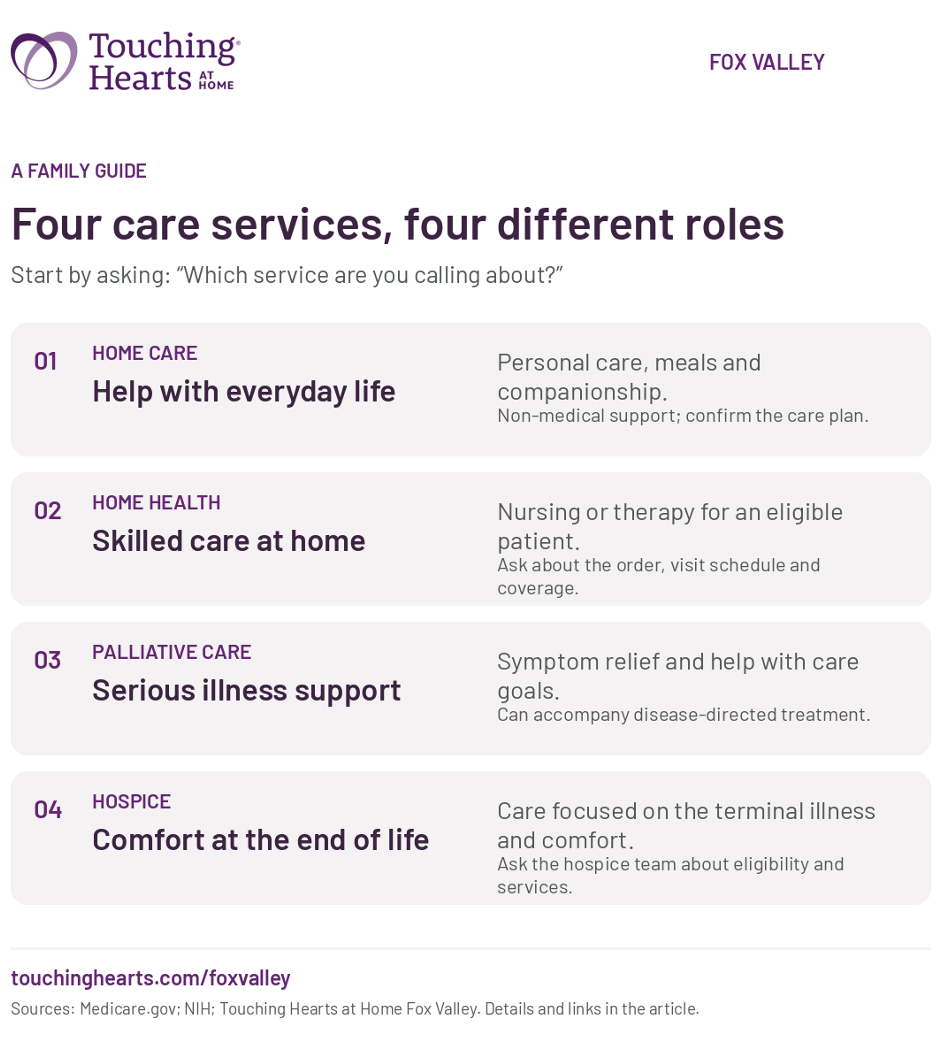
They serve different needs. Home care helps with everyday activities. Home health provides skilled services at home. Palliative care supports people living with serious illness, including during treatment. Hospice focuses on comfort at the end of life. A person may use more than one service, depending on their needs and eligibility. [1–4]
Our Learning from the Heart conversation with Marilyn highlighted why families need to understand their options. Use this guide during your next call and share it with those arranging care.
First, ask what matters to your loved one
Before comparing agencies, ask: “What would make your day easier?” and “Which routines do you want to keep?” Marilyn emphasized listening to the wishes of the person receiving care, as well as understanding the family’s concerns.
Try this: Write down three needs—perhaps help bathing, a clinical question and time for a family caregiver to rest. Ask each agency which needs it can address.
What each type of care does
Home care: help with everyday life
Non-medical home care can include personal care, meal preparation, companionship and light housekeeping, depending on the agency and agreed plan. It does not replace a nurse or therapist. Touching Hearts at Home Fox Valley provides non-medical home care. [4]
Ask: “Can you help with these specific tasks? What schedule can you provide, and what are your rates, minimum visit lengths and backup arrangements?” Medicare does not cover personal care when that is the only care needed. [1]
Home health: skilled services at home
Home health may include nursing, physical therapy or other skilled services. Medicare coverage requires eligibility, including a need for intermittent skilled care and being homebound, plus an order from an eligible health care provider. [1]
Ask: “What was ordered? Who will visit, how often and for how long? Who helps between visits?” A scheduled visit is not a plan for the entire day.
Palliative care: support during serious illness
Palliative care helps address symptoms, stress and goals during serious illness. It can accompany treatment for the illness; a referral does not automatically mean hospice. It may be offered by a team within a hospital or another organization rather than a separate agency. [3]
Ask: “How could your team help with symptoms or decisions? Where are appointments held, and how will you work with our regular clinician?”
Hospice: comfort at the end of life
Hospice focuses on comfort instead of treatment intended to cure the terminal illness and related conditions. Medicare eligibility includes physician certification of a life expectancy of six months or less; care can continue beyond six months with recertification. Hospice can often be provided where the person lives. [2]
Ask: “What services and visits are included? What remains the family’s responsibility? How does after-hours support work?” Clarify whether “24/7 availability” means phone support, urgent visits or someone physically present.
Different services can work together
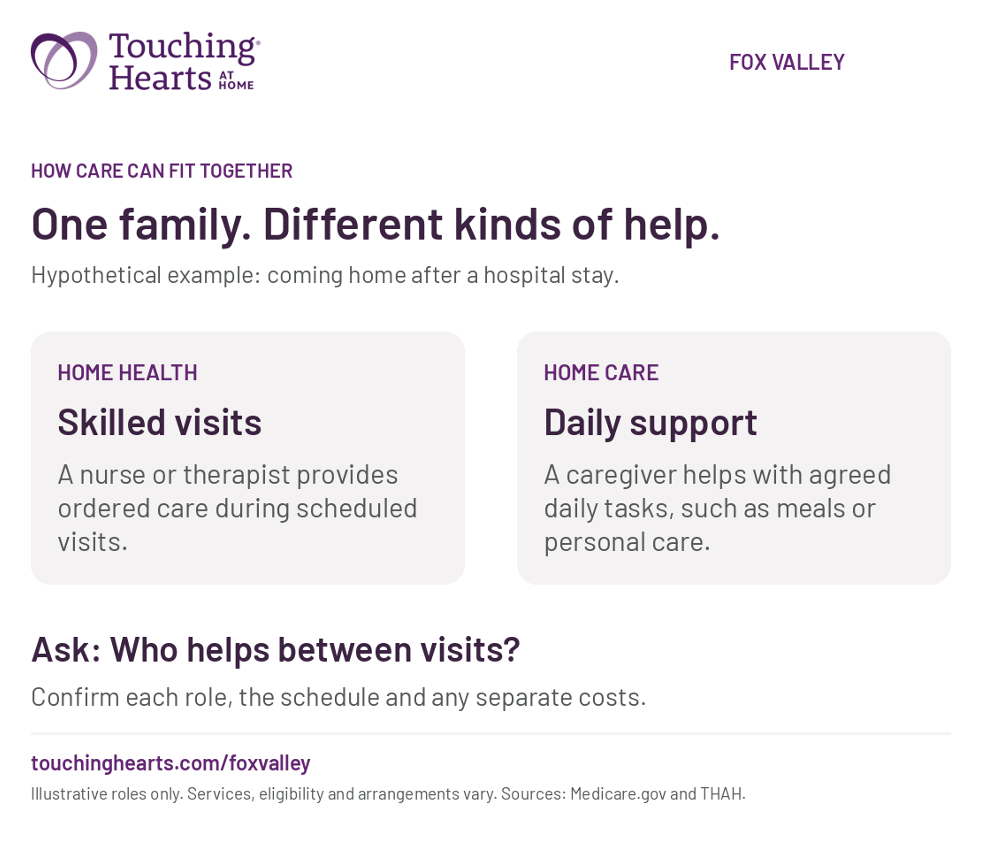
A hypothetical example: After a hospital stay, a parent has scheduled home health visits and also needs help preparing meals and getting dressed. A home care arrangement may address those daily tasks while the home health team handles ordered clinical services. Confirm responsibilities and costs separately. [1] [4]
Use this script when an agency calls
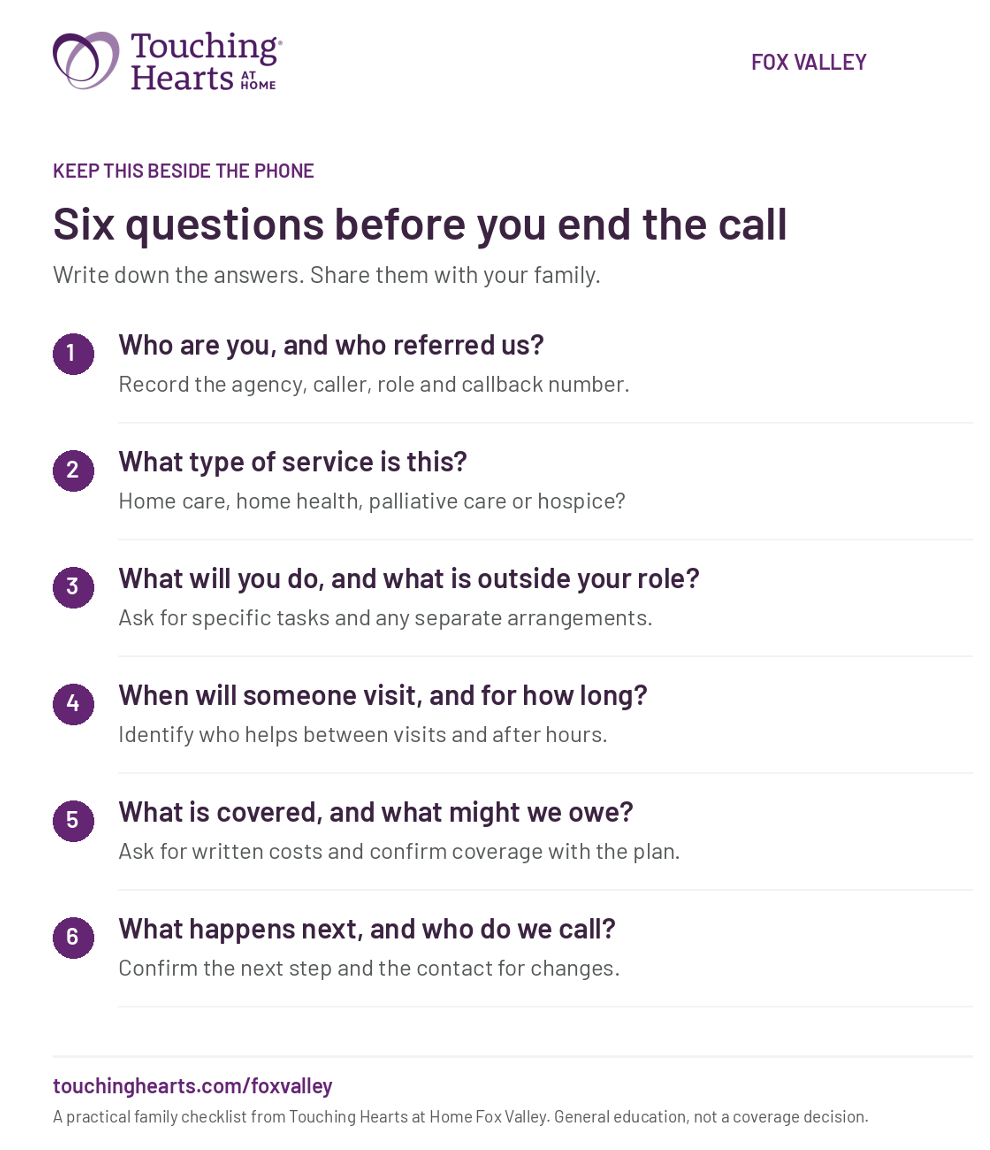
“Thanks for calling. We’re talking with several providers and want to keep everything straight. Could you tell me your agency name, who referred us, what type of service you provide and what you would do for our family?”
If you do not recognize the referral, confirm it with the clinician or discharge team before sharing sensitive information.
Before your family makes a decision
Put the answers in one shared note. Use the same format for each provider:
Agency and service: ___
What they will do: ___
Visit schedule and first visit: ___
Costs or coverage still to confirm: ___
Needs we still have to arrange: ___
Main and after-hours contacts: ___
Next step and who owns it: ___
Today’s action: Share that note, choose one person to track callbacks and include your loved one in the conversation as much as possible. Ask the clinical team to address medical questions before deciding on services.
Two questions families often ask
Does a hospice referral mean we have already enrolled?
No. Medicare hospice enrollment includes an election statement and eligibility requirements. Ask what any document means before signing it. [2]
Can someone receive both home health and hospice?
Sometimes. Home health for a condition completely unrelated to the terminal condition may be possible, with the required eligibility and documentation. Ask both teams to coordinate and confirm coverage for the specific situation. [5]
This guide provides general education. Your clinical team determines medical needs; coverage and service availability depend on your situation.
Sources and further reading
- Medicare: Home health services
- Medicare: Hospice care
- MedlinePlus: What is palliative care? and NIH: Support for serious illness
- Touching Hearts at Home Fox Valley: Services
- CGS Medicare: Home health and hospice
Inspired by our Learning from the Heart interview with Marilyn. Service and coverage explanations were checked against the sources above on October 11, 2026.
Start with the help your family needs
If you are exploring support with everyday activities, contact Touching Hearts at Home Fox Valley to discuss non-medical home care. Bring your questions and the list you made. Understanding what each provider does is a useful first step toward a plan everyone can explain.
You may also like:
Recline = Decline
On July 1, 1946, the Communicable Disease Center (CDC) opened its doors and occupied one floor of a small building…